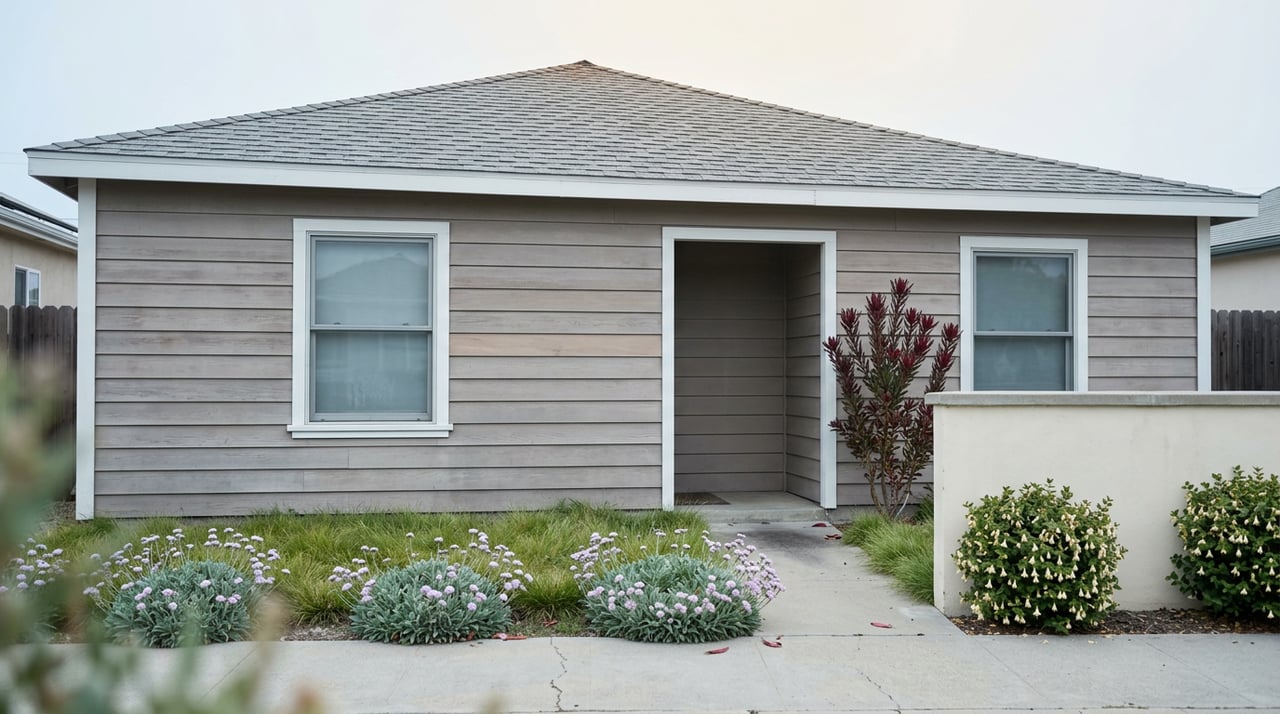
If you are looking at a listing on Seacoast Drive or Carnation Avenue in Imperial Beach right now, the seller's disclosure package will contain a line item most California sellers never have to write: a beach closure history statement. Under California Civil Code Section 1102, a seller must disclose known material facts that affect a property's desirability or value, and the county's Department of Environmental Health and Quality has closed stretches of Imperial Beach's shoreline often enough, and long enough, that closure history now counts as one. As of this week, the ocean shoreline from the international border to three quarters of a mile north of the Tijuana River is closed to water contact, along with the Imperial Beach Pier, Carnation Avenue, the south end of Seacoast Drive, and, as of a county notice issued August 22, Cortez Avenue.
That disclosure line is where most coverage of Imperial Beach real estate stops. A headline number gets attached to it and the story ends. But the number itself does not hold together the way it is usually presented, and understanding why is the difference between shopping this market with a plan and shopping it by rumor.
The number everyone quotes, and the number that contradicts it
In April 2026, Sandi Crosby, president of the Imperial Beach Chamber of Commerce and a local real estate broker, told federal officials visiting the city that property values there are down an estimated 12 to 15 percent, and that Imperial Beach is the only beach community in California where values have declined in recent years. That figure has since traveled through national coverage of the Tijuana River sewage crisis as the headline stat for what the pollution has cost homeowners.
Here is what sits next to it, largely unremarked: over the three months ending in May 2026, the median sale price of a home in Imperial Beach was $852,000, up 3.3 percent from the same period a year earlier, with homes selling faster than they had the year before. Meanwhile, a separate estimate of typical home value across the entire local housing stock put that figure at roughly $816,000 as of mid-2026, down about 1.1 percent year over year.
Three numbers, three directions. That is not a data error. It is what happens when an economic shock hits a market unevenly and everyone keeps reporting the average as if it hit evenly.
| Metric | Window | Direction |
|---|---|---|
| Chamber estimate of citywide property value decline | Cited April 2026 | Down 12–15% |
| Median sale price of homes that actually closed | 3 months ending May 2026 | Up 3.3% year over year |
| Typical value across the full housing stock | As of mid-2026 | Down 1.1% year over year |
A median sale price only reflects the homes that transacted. If damaged or exposed properties are sitting unsold, or selling at a discount too small to appear in a thin monthly sample, while updated inland homes keep closing at strong prices, the median can rise even while the "typical" home is worth less than it was. That is the mechanism. The discount is real. It is just not smeared evenly across every address with a 91932 zip code.
Where the damage actually concentrates
The crisis has a shape, and the shape follows the Tijuana River's plume and the wind, not the city limits. The closure zones named in the county's own notices this week, Tijuana Slough, the Imperial Beach Pier, Carnation Avenue, the south end of Seacoast Drive, and Cortez Avenue, sit along the coastline closest to the river mouth. A peer-reviewed study published in Science by researchers from UC San Diego's Scripps Institution of Oceanography, UC Riverside, San Diego State University, and the National Science Foundation found that the river emits hydrogen sulfide at levels up to 4,500 times higher than typical urban environments, with some Imperial Beach neighborhoods recording hourly averages 70 times the state's air quality standard. The word "some" is doing real work in that sentence. The gas is aerosolized most heavily near a stretch of the river known locally as the Saturn Boulevard hotspot, and the city has since placed boulders along the riverbank there specifically to interrupt the gas release. Exposure is not uniform because the geography of the pollution is not uniform.
The business damage tracks the same map. Mike Hess Brewing's Imperial Beach location has seen revenue fall roughly 28 percent from its 2022 peak, a decline severe enough that Hess said 25 banks declined to finance an unrelated expansion in Los Angeles after flagging the location's performance. Katy's Café, a longtime beachside spot near the pier, saw business drop sharply after 2020 coverage labeled Imperial Beach one of the most polluted beaches in the country. Both businesses sit inside or immediately adjacent to the closure corridor. County Supervisor and former Imperial Beach mayor Paloma Aguirre has since commissioned a regional economic study specifically to quantify how much of this damage is concentrated versus dispersed, a project still underway as of this spring.
None of that reads as an argument against buying in Imperial Beach. It reads as an argument against treating "Imperial Beach" as a single unit of analysis when the data clearly is not one.
What still gets built here
If the whole city were uniformly written off, capital would have stopped flowing months ago. It has not. In June 2026, the Imperial Beach City Council unanimously approved a new three-story mixed-use development from Far West Industries on a vacant lot at Seacoast Drive and Date Avenue, adding four townhomes, two split-level units, rooftop solar, and ground-floor commercial space. Councilmember Mariko Nakawatase noted that "external factors" are what keep some of the city's existing mixed-use spaces sitting empty, not a lack of underlying demand for the location itself. A developer betting new construction on a Seacoast Drive parcel in the middle of an active water-contact closure is a signal worth more than another paragraph about the citywide average.
The VA angle nobody prices in
Imperial Beach's housing stock is largely original construction from the 1950s through the 1970s, and salt air accelerates wear on roofs, electrical panels, and exterior wood in ways that show up during VA appraisals. VA loans are one of the largest sources of qualified, motivated buyers in this market, since the Silver Strand puts most Imperial Beach addresses within 15 to 20 minutes of the gate at Naval Air Station North Island, a commute comparable to or shorter than Chula Vista or National City. Sellers who skip a pre-listing inspection for roof condition, HVAC capacity, or panel age often find those same items surfacing mid-escrow as VA Minimum Property Requirement issues, at exactly the point a delay costs the most leverage. Buyers using VA financing should expect an appraiser to look closely at these same items, particularly on homes closer to the coast.
Three questions before you write an offer
Instead of asking whether Imperial Beach is a good market, ask these three questions about the specific address:
- Is the property inside the current water-contact closure boundary, and how has that boundary moved over the last two years? The county's beach closure line and 24-hour hotline (619-338-2073) publish current status at sdbeachinfo.com.
- What does UC San Diego's hydrogen sulfide monitor show for that block during a high-flow period? The university publishes 48-hour, 12-hour, and 30-minute readings by location.
- What does the Transfer Disclosure Statement and Seller Property Questionnaire actually say about closure history, odor complaints, and any related repairs, and does that match what a walk of the block on a warm afternoon tells you?
Answering those three questions for one specific address tells you more than any citywide percentage ever will.
Quick FAQ
Is all of Imperial Beach affected by the sewage crisis the same way? No. Closures and hydrogen sulfide exposure concentrate near the river mouth and the Tijuana Slough, the pier, Carnation Avenue, the south end of Seacoast Drive, and now Cortez Avenue. Homes farther from that corridor have not shown the same pattern of price pressure.
Does this affect financing? Beach closure history itself is not a lending issue. What can affect financing is deferred maintenance common in older coastal homes, which shows up during VA and conventional appraisals regardless of the sewage situation.
Where can I check current conditions before touring a home? The county's beach closure dashboard at sdbeachinfo.com and UC San Diego's hydrogen sulfide monitoring portal are both updated regularly and are the most current sources available.
The 12 to 15 percent figure making the national rounds is not wrong. It is just answering a different question than the one a buyer actually needs answered, which is what a specific block, on a specific street, is worth right now. That is a block-by-block question, and it is the kind of question we spend our time on with every South Bay client. If you are weighing a specific Imperial Beach address against the headlines, the Leo Gonzalez Team can walk the closure map, the disclosure history, and the comps with you before you write an offer. Schedule Your White-Glove Consultation whenever you are ready to look past the average.
